

Garden tour
NEWEST GARDEN TOUR:
What Grows on the Habitat Tree and Deadwood? – Tree-Related Microhabitats
This guided walk highlights the importance of deadwood and habitat trees. How many living organisms depend on dead trees during their life cycle? How does deadwood contribute to the healthy functioning of forests? During our walk, you will get answers to these questions and discover many other fascinating facts.
Useful Even in Death – Deadwood in the Forest
Deadwood is an essential part of the forest nutrient cycle. It plays an important role in water retention and slowing runoff, serves as one of the driving forces of forest soil formation, and acts as a long-term organic carbon store, making it an important element of climate protection.
Living trees also contain a considerable amount of decaying wood, since they often have smaller or larger dead parts. Moreover, the transition between living wood and deadwood is frequently gradual, without a sharp boundary between them.
Standing dead trees, fallen trunks, and other forms of deadwood provide habitat for thousands of organisms. Insects and fungi develop within them, plants establish themselves on them, and vertebrates use them as shelter. Around 30–40% of forest species are associated with deadwood, and many of these species cannot survive without it—either during a specific stage of their life cycle or throughout their entire lives. Deadwood is therefore among the most important habitats for preserving forest biodiversity. Without deadwood, thousands of tiny organisms—barely visible to the naked eye—would disappear from the forest, even though they are essential for the functioning of healthy forest ecosystems.
Woodpeckers and Cavity-Dwelling Species
The woodpecker species use wood as feeding and nesting habitat, seven of the nine species found in Hungary are restricted to forests. Among them, the lesser spotted woodpecker and the middle spotted woodpecker can utilize only well decayed wood (especially in case of hardwood tree species). The white-backed woodpecker has particularly high demand for deadwood quantity and quality, as it feeds almost exclusively on insect larvae living in deadwood and also prefers dead trees for nesting.
Woodpeckers create more nesting cavities than they actually use and many other bird species (e.g. tits, flycatchers) can use their cavities as nesting site. Without this “surplus” of cavities, many animal species would not be able to establish themselves in our forests. Because of this function we can call the woodpecker as keystone species of forest communities. About one-third of Hungary’s forest bird species are cavity nesters, and many of them are insectivorous. During chick-rearing, they feed almost exclusively on insects (e.g. leaf-eater caterpillars), helping to control species that can cause large-scale damages. It has been proven that their regulatory role is far more effective in forests where deadwood is present.
Is Deadwood Beneficial for Plants Too?
Yes. Herbaceous plants and mosses, for example, are able to establish themselves on the bark and wood of dead trees. Deadwood also plays a role in forest regeneration. In coniferous forests or swamp forests—where conditions on the forest floor are unfavorable for germination—young trees can grow on fallen trunks, known as “nurse logs.”
What Is a Habitat Tree?
A habitat tree is a tree that provides more microhabitats for different groups of living organisms than surrounding trees in the same area, thereby creating conditions for local biodiversity.
A habitat tree is often a larger tree specimen featuring cavities, decaying trunk sections, bracket fungi, peeling bark plates, or drying thick crown branches. Such trees may also be characterized by irregular growth forms, forked trunks, or gnarled shapes.
Even an average-sized tree can qualify as a habitat tree if it contains a unique microhabitat or provides essential living conditions for endangered species (for example, a large trunk cavity).
Habitat trees are important because hollow and cavity-bearing trees provide refuge for a significant part of forest wildlife. For many species, they are indispensable and irreplaceable sources of shelter, habitat, and feeding grounds throughout all or part of their lives.
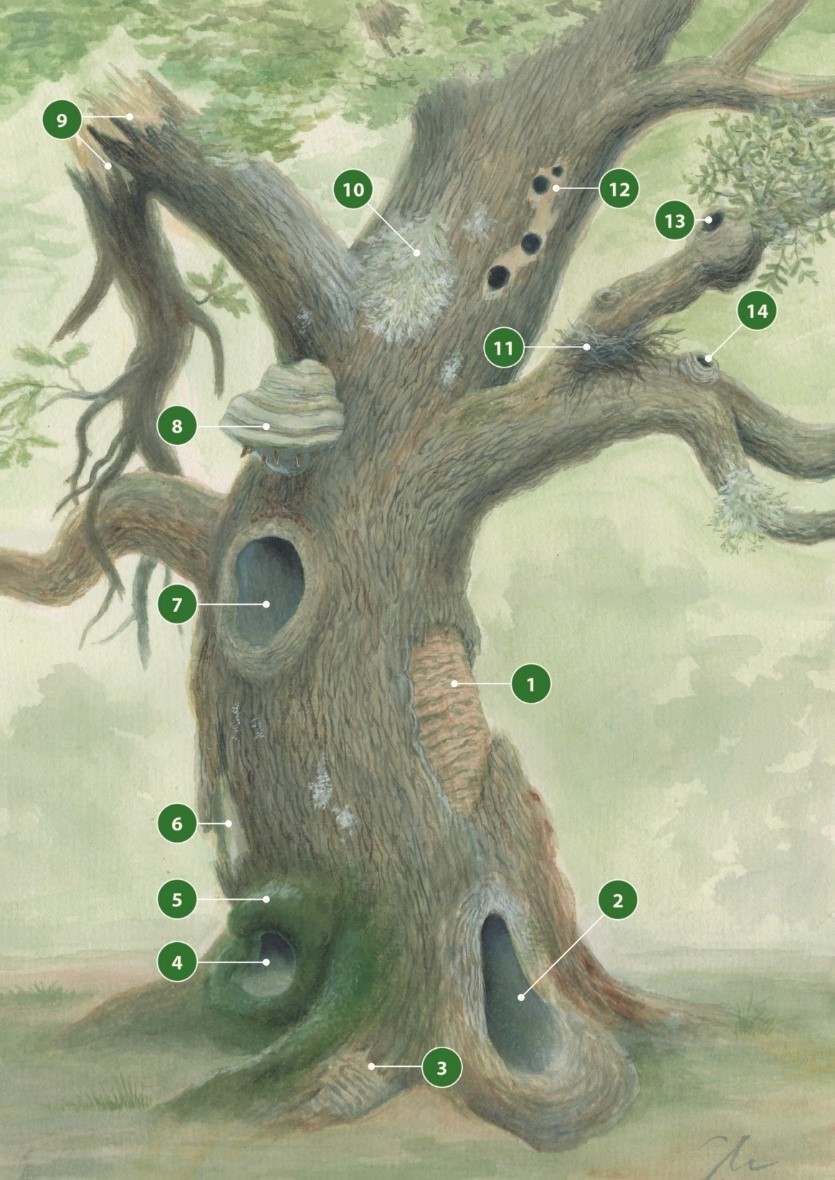
Tree Microhabitats (TreMs) on a Habitat Tree
- Insect galleries (e.g. galleries of the great capricorn beetle, Cerambyx cerdo) within a bark loss area
- Large basal cavity containing wood mould
- Dead and decaying coarse root
- Water-filled tree cavity (dendrotelm)
- Moss mat
- Bark loss area and loose bark plate (bark pocket)
- Trunk cavity formed at the break point of a large scaffold branch
- Bracket fungus fruiting body
- Broken large branch and branch stub with exposed heartwood
- Lichen cover
- Nest of a vertebrate species (bird or small mammal)
- Woodpecker cavities (woodpecker holes)
- Cavity associated with a mistletoe gall
- Decaying branch knot cavity (branch-base cavity)